
The False Religion of Climate Alarmism
This article was published in our recent Social Issues Bulletin – Issue 59, which is available to download here.
A longer version of this article, with fuller references, is available on the Jubilee Centre website.
This article critiques climate alarmism, defined as the belief that human influences on the climate, through greenhouse gas emissions, will lead to catastrophic outcomes if unchecked, arguing that this perspective does not align with a biblical response to environmental concerns. While many claim that human activity contributes to climate change and requires action, the accompanying exaggerated or apocalyptic narratives warrant scrutiny from a Christian perspective.
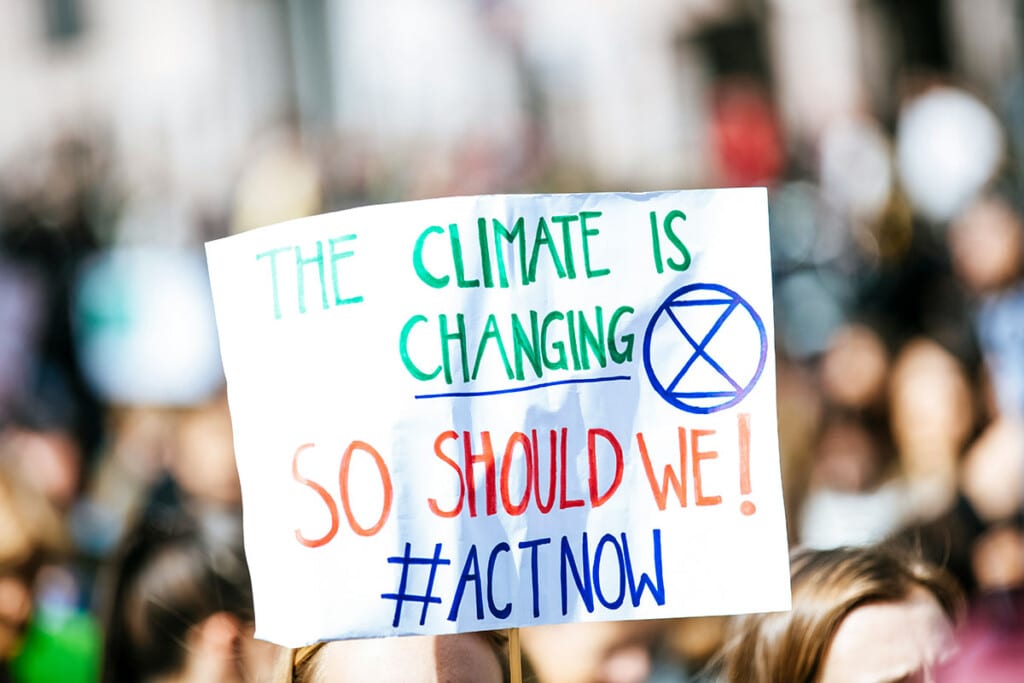
Such alarmism often adopts quasi-religious characteristics, reflecting a deep emotional commitment to environmental causes. This is evident in the passionate rhetoric and symbolic actions of some activists, such as those in movements like Extinction Rebellion, who engage in dramatic protests or disrupt infrastructure to highlight their concerns. It is often argued that these extreme narratives have filled a spiritual void in Western societies as adherence to Christianity has declined.
Given these religious overtones, one might have expected Christians to be cautious in endorsing such thinking, but some denominations have fully embraced the ideas of climate redemption. For example, The Church of England (CoE) is committed to net zero emissions by 2030 and, in 2022, took on £250mn of debt to fund green projects.[1] Pope Francis asserted that humanity is unquestionably responsible for climate change while excoriating ‘climate change deniers’.[2] Evangelical climate advocate Katherine Hayhoe says she is motivated by her faith to warn of the ‘unprecedented’ climate changes to come.[3] Such Christians often apply the imperative given to steward the Garden of Eden (Gen 2:15) as a requirement to decarbonise energy usage. Christian sceptics are therefore criticised for not understanding the ‘integrated gospel’.[4]
To aid Christian discernment, this paper describes the religious worldview aspects and trappings of climate alarmism assesses its ‘fruit’.
The religious worldview of climate alarmism
As with other worldviews, that of climate alarmism can be categorised as one of creation (original state), fall (the problem), redemption (the solution), future judgement (apocalypse), and heaven (the ideal future state).
Creation. The natural world is viewed as inherently benign. Hence the pre-industrial climate was relatively stable, natural and good.
Fall/the Problem. Humanity is held responsible for despoiling the Earth not only through pollution and habitat destruction but also by releasing greenhouse gases (notably carbon dioxide (CO2), but also methane and nitrogen oxides) into the atmosphere, thereby inducing ‘catastrophic climate change’.
Redemption/the Solution. Humanity can atone for its sins of greenhouse gas emissions by decarbonising energy usage imminently.
Future Judgement/the Apocalypse. If emissions continue, then humanity will face judgement through rising global temperatures, which are then forecast to unleash droughts, forest fires, rising sea levels, flooding and extreme weather events.
‘Heaven’/the ideal future state. Embedded within this worldview, the ideal outcome would be a return to ‘Eden’, that is, pre-industrial human emissions and global temperatures.
The religious trappings of climate alarmism
As with all religious paradigms, the framework of the worldview has social and moral manifestations. These include:
Moral purity. The righteous life is one in which emissions are minimised through recycling, eating less (or no) meat, reducing car and air travel and using non-carbon emitting sources of electricity, heating and transport.
Indulgences/penances. Remission for one’s sins of emission can be obtained by purchasing carbon offsets and installing solar panels and heat pumps to generate electricity, thereby assuaging the guilt associated with air travel or a steak.
Priestly caste. The highest esteem is afforded to those politicians, billionaires, climate scientists and celebrities who promote the alarmist narrative. Faux-sainthood is even bestowed upon some.[5]
Prophecies. Climate alarmism often emphasises dire predictions about rising temperatures and extreme weather, urging immediate action to avert catastrophic outcomes.
Overriding priority. The belief in an urgent climate crisis can lead to prioritising decarbonisation over other considerations, usually without fully exploring cost-benefit trade-offs.
Heretics. Those who question aspects of climate science or policy are often labelled ‘climate change deniers,’ an insult intended to stifle open debate.
Miracles. The view that trace CO2 emissions are the primary driver of global temperature,[6] or that power grids can rely solely on intermittent renewables, involve significant leaps of faith.
Ignoring history. Some alarmist narratives overlook the natural variability of Earth’s climate, such as cycles of warming and cooling, including the relatively cold period (the ‘Little Ice Age’) we are emerging from.
Even for those convinced that there is a scientific consensus on human-made global warming, some caution should be exercised regarding this religious approach.
Yet, in this debate, we are presented with a stark choice in which the stakes could not be higher. A climate apocalypse is predicted if action is not taken imminently. This message has been repeated by some Christians without qualification in terms of the theological perspective or the scientific limitations.
For example, it could be argued that the costs of decarbonising are so vast that its achievement would entail significant depopulation and immiseration. How can Christians who care about both stewarding creation and the alleviation of poverty be discerning?
This is especially difficult because the overwhelming majority of us are not climate scientists and cannot easily weigh up the evidence. We might be convinced that the climate is different to when we were younger, but how much is natural cycling, how much is actually caused by human activity, how much can we actually do about it and at what cost, are complex questions.
The ‘bad fruit’ of climate alarmism
Some of the ‘bad fruit’[7] of climate alarmism includes:
Predictions have been inaccurate: a series of dated forecasts that have proved to be wildly incorrect, from an ice-free North Pole, to the inundation of coral atolls, to dwindling polar bear numbers and coral reefs.
Environmental impacts. The shift to renewable energy sources, such as wind and solar, requires significant land use and mining of heavy and rare earth metals, sometimes under ethically concerning conditions. The claim that burning biomass, such as wood, is carbon-neutral has contributed to the loss of ancient forests, raising questions about whether such initiatives align with environmental goals, especially as rising CO2 levels are linked to increased global vegetation growth.[8]
The push for decarbonisation at all costs results in policies which aren’t always fully thought through. The UK pays wind turbine operators £0.4bn a year to shut off when there is too much wind and £0.6bn to back-up generators when there is too little; we pay another £0.9 bn to subsidise the burning of wood chips from ancient US forests; we have banned fracking and new coal mines thereby increasing global emissions through energy imports at extra cost; we are conducting experiments to dim sunlight whilst subsidising uneconomic solar power. Dangerous chemicals are being fed to cattle just to reduce methane emissions. Only the zealotry of a false religion can accommodate such contortions of logic.
Censorship of opposing views. As the ‘Climategate’ scandal revealed, climate alarmists sought to prevent the inclusion of sceptical viewpoints in the UN’s Intergovernmental Panel on Climate Change (IPCC); the UN is advocating the criminalisation of climate misinformation; and the G20 recently pledged to step up efforts to censor sceptical viewpoints. Only a dogmatic religious perspective would seek to suppress opposing viewpoints on such a controversial scientific topic.
Economic and social consequences. Access to affordable, reliable energy is crucial for economic prosperity and human well-being. However, the push for rapid decarbonisation has led to higher costs, deindustrialisation, and challenges for poorer nations seeking to develop their energy infrastructure. This raises concerns about balancing environmental goals with the needs of vulnerable populations.
The fabrication and manipulation of data. Climate alarmists have frequently adjusted and manipulated data. This has ranged from the notorious ‘hockey stick’ graph from the IPCC’s 2001 report to studies claiming that ‘97% of climate scientists agree that humans are responsible for climate change’. Such deception extends to the continuing use of temperature data from poorly sited stations prone to upward bias through urbanisation (the ‘urban heat island effect’).
The corruption of ‘science’. Climate alarmists often claim that the science is ‘settled’. Apart from the most trivial of questions, this should never be the approach to scientific enquiry, let alone that concerning the climate, which poses perhaps the most difficult modelling problem in nature. The IPCC’s cohort of climate models all over forecast global temperatures. Yet these simplistic and flawed models are used to justify the outlay of vast resources.
Climate alarmism has achieved a negligible impact on humanity’s emissions despite huge subsidies, just as atmospheric CO2 levels rise inexorably. Those subsidies have yielded some improvements in electric vehicles, solar and battery technologies, but fossil fuels still supply over 80% of the world’s energy. The nuclear power renaissance may be the only lasting benefit to humankind that the imperative to decarbonise may impart.
A Biblical view of climate
In contrast to the alarmist religious framework, what does a biblically based position look like?
Creation. Initially, God declares Creation to be ‘very good’ (Gen 1:31) and entrusts his image-bearers with the responsibility to subdue, populate and care for the Earth and Garden (Gen 1:28; 2:15).
Fall. The disobedience of God’s image-bearers results in the created order being cursed (Gen 3:17-19). As a result, ‘the creation was subjected to frustration’ but will one day ‘be liberated from its bondage to decay’ (Rom 8:20,21).
Flood. Due to humanity’s wickedness, God judged both the Earth and humanity through the ultimate climate emergency – a global inundation that only eight people survived (Gen 6:5-8:19).
The Noahic Covenant. Following the Flood, God commits never to curse the ground or flood the earth again (Gen 8:21; 9:8-11). He specifically promises that harvests, temperature variations and seasons will not cease (Gen 8:22). The mandate to procreate is given to animals (8:17) and reaffirmed for humanity (9:1). It is never subsequently rescinded or modified.
The Mosaic Covenant. Having rescued the people of Israel from oppression, God promises that if his law is obeyed, the people will enjoy the blessings of regular rainfall, abundant harvests and increasing population (Lev 26:3-13). However, drought, poor harvests, depopulation and exile would be the result of disobedience (Lev 26:14-46).
Old Testament history. These latter promises were carried out, notably regarding the drought brought as punishment for the idolatry practised under Ahab and Jezebel (1 Kgs 17-18) and at the time of Jeremiah (ch.14).
Jesus’ prophecy of the ‘end times’. When describing the period before the ‘end’, Jesus notes that the time prior to his re-appearing will be characterised by seeming normality, with life events (feasting, marriage) occurring as usual (Matt 24:37-41).
The final destruction will be by fire, not water. The current created order will be destroyed by fire (2 Peter 3:7,10), consistent with God’s promise not to flood the Earth again.
What can Christians discern from this teaching that is relevant to the climate debate? Briefly, we can see that:
Creation is not to be worshipped but subdued and stewarded. We should not regard the natural world as sacred, but a place to be both developed for humanity’s good and cared for, both for its intrinsic value to God and for future generations.
The mandate to procreate still applies. The Bible is unequivocally pro-natalist, with the birth of children always a blessing. The sense of the Noahic covenant is one of measured optimism over humanity’s resource and environmental future, rather than strident Malthusian apocalypticism.
God is sovereign over extreme weather events. God’s power over storms, floods, hail, etc. is never in doubt (e.g. Job 37,38; Ps 107:25,29). However, outside the Mosaic covenant, it is hazardous to attribute any specific weather event directly to God’s particular judgement.
God promises that seasons and harvests will continue until Christ returns. The sense of the Noahic covenant is one of an equilibrating, stable system that will self-correct if disturbed (c.f. Eccl 1:4-7). Jesus prophesied that the time prior to his return will be strikingly ‘normal’. The end of the world will not be widely anticipated.
The Christian response to climate alarmism
Christians need to be discerning about the substantial costs and technical challenges of decarbonisation, which may have limited impact on global emissions. While some argue that a moderately warmer planet could pose significant risks, such as disruptions to ecosystems or increased extreme weather, the evidence does not indicate that these changes would fundamentally threaten the survival of humanity or nature as a whole. True stewardship involves carefully weighing these potential risks against the economic and social consequences of rapid decarbonisation, such as increased poverty or reduced access to reliable energy. Christians supporting this agenda should consider whether it aligns with the biblical call to care for the global poor, as the trade-offs could exacerbate hardship for vulnerable populations.
For those unconvinced by this analysis, I would make various pleas. First, please do not disparage fellow Christians who think differently. It is not a belief necessary to uphold gospel truth or unity within a fellowship. It is a matter over which we can legitimately differ (e.g. 1 Cor 8:4-13). Stewardship of the environment should never be conflated with support for net-zero emissions – indeed, in many ways, they are diametrically opposed. The pejorative label of ‘climate change denier’ should be banished from our fellowships.
Second, please examine seriously the religious, scientific and economic claims underpinning climate alarmism. Just because a consensus has been reached amongst some[9] doesn’t make it correct, as advocacy of eugenics in the 1930s and global cooling in the 1970s demonstrate. Any science worthy of the name should welcome challenge to its received tenets, not censor and disparage sceptics. Christians, above all, should value intellectual humility, for only God is omniscient.
Finally, please resist the pessimism inherent in the alarmist mindset. There are numerous benefits from a gently warming planet, and we should thank God that we no longer endure the ‘Little Ice Age’. The world will only end tomorrow if Christ returns. Before then, God has promised that seedtime and harvest will continue. Have children if possible, invest in the future, eat meat if you like and travel without any artificial feelings of fear or guilt. For these are the trappings of the false religion of climate alarmism.
Footnotes:
[1] “Decarbonisation must permeate every aspect of our lives” – The Bishop of Norwich, 21st September 2023: https://www.churchofengland.org/media/press-releases/bishop-norwich-responds-net-zero-statement.
[2] Laudate Deum, 2023. https://www.vaticannews.va/en/pope/news/2023-10/laudate-deum-pope-francis-climate-crisis-laudato-si.html
[3] “Evangelical Scientist Warns”, Evangelicals Now, 1st July 2022: https://www.e-n.org.uk/world-news/2022-07-evangelical-scientist-warns/
[4] See: https://www.e-n.org.uk/features/2025-02-why-arent-christians-leading-on-climate-change/
[5] https://www.telegraph.co.uk/environment/2019/09/28/greta-thunberg-first-saint-cruel-new-environmental-religion/; https://thecatholicherald.com/tv-wildlife-presenter-poses-as-st-francis-of-assisi-in-new-portrait/
[6] Carbon dioxide currently constitutes around 430 parts per million (ppm) of atmospheric gases, roughly 0.04%. It is dwarfed by water vapour – a far more powerful greenhouse gas. It has risen from around 270ppm since the mid-C18th. Of this 160ppm rise, the large majority has likely been natural.
[7] Matthew 7:15-17.
[8] https://www.sciencedirect.com/science/article/abs/pii/S0034425724005200?via=ihub;
[9] There are numerous, eminent earth scientists, physicists etc. who disagree with the assertions of climate alarmism; see the Clintel Declaration: https://clintel.org/world-climate-declaration/.

Related articles



Stay connected with our monthly update
Sign up to receive the latest news from Affinity and our members, delivered straight to your inbox once a month.