We must keep on fighting the Government’s conversion therapy plans
This article was first published in our recent Social Issues Bulletin – Issue 60, which is available to download here.
Christians in the Australian state of New South Wales have united against a new law that threatens the freedom to proclaim the Gospel of repentance to all people. The NSW Conversion Practices Ban Act 2024, which came into effect in April, criminalises any practice aimed at ‘changing or suppressing’ an individual’s ‘sexual orientation’ or ‘gender identity’. The penalty? Up to five years in prison or a maximum fine of A$100,000. Official state guidance on how to comply with the law confirms just how repressive it is, since encouraging an individual to embrace celibacy outside of marriage, or praying with a person at their request, could be deemed an attempt to change or suppress that person’s sexual orientation and therefore constitute a criminal offence.
The Sydney Anglican Synod passed a motion in September encouraging Christians to be unafraid to proclaim the truth of God’s Word in matters relating to marriage, sexuality and identity – even if it risks a complaint under the state’s ‘conversion practices’ law.1 Sydney Archbishop Kanishka Raffe said: “I want to say this clearly and publicly to you all, that I will stand by any clergy person or church worker who finds themselves brought before a tribunal or court because of this poorly conceived law… We must not be silenced or intimidated from teaching God’s good plan for human sexuality and relationships. We will insist on the freedom to do so respectfully, but without fear, we will obey God. We can do nothing less.”2 The Presbyterian Church of NSW joined its Anglican brethren in affirming that it will continue to promote biblical sexual ethics and support people to live in line with their faith.3
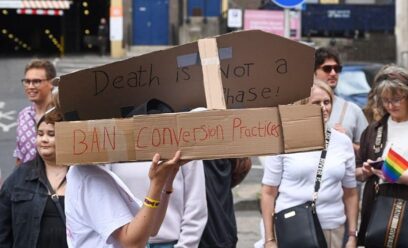
The pushback from our Australian brothers and sisters should serve as a challenge to us here in the UK. With the Westminster Government set to publish its own draft ‘conversion practices’ Bill for England and Wales soon, it’s important that we too use every opportunity to push back against activist demands for a law that would trample gospel freedom. We must continue to draw attention to the many legal opinions from leading KCs which affirm that existing law in this area is already sufficient to protect everyone from actual abuse.4 And we must continue to make the case that broadening the criminal law in this way will only see innocent actions – like prayer and pastoral conversations – brought within its scope.
A good example of this is the recent open letter to the Westminster Government, drafted by 24 church leaders from across Great Britain, including Affinity Director Graham Nicholls. In response to Westminster’s pledge to publish a draft bill for pre-legislative scrutiny, the church leaders warn that a conversion therapy law “could criminalise mainstream, historic Christian teaching on marriage and sexual ethics, and make sharing the Gospel with some people illegal”.5 They also warn that this law could criminalise parents – Christian or not – from engaging in conversations with their children about sex and sexuality. More than 6,000 Christians have added their name to the letter supported by The Christian Institute campaign Let Us Pray, including over 1,300 church leaders. (You can sign the letter here: letuspray.uk/letter.)
When the Scottish Government published its proposals for a conversion practices law last year, we encouraged Christians in Scotland to pray and to act. The results of the consultation were published in October. This revealed that the majority of respondents opposed the plans.6 Of the 5,811 responses – which is a remarkably high response rate in Scottish terms – 52% opposed a new law covering “acts or courses of behaviour intended to ‘suppress’ another person’s sexual orientation or gender identity”. 46% were in support, with two per cent unsure.
Many highlighted the threat to religious freedom. Some expressed concern that the proposals risk “criminalising religious leaders whose role is to guide others in line with their beliefs”, arguing that proposed exemptions for ‘non-directive’ guidance fail to recognise that pastoral support often involves providing direction. Similar concern was expressed regarding parents. Respondents warned “that legislation could encroach on the rights of parents and carers and that people could be criminalised for acting in what they believe to be the best interest of their child(ren)”.7
Interestingly, the Scottish Government did not push ahead with those plans. Bizarrely, for the SNP, it has asked Westminster to legislate for Scotland, while pledging to bring in its own law if Westminster’s is inadequate. This feels like an effort to long-grass the issue. All of this is testament to the importance of sustained pushback. Now is not the time to retreat or slacken. It’s vital we keep speaking out and help others in our churches understand the threat a conversion therapy law poses to gospel freedom, so that when the Westminster Government does publish its draft Bill, we are ready to respond.
Joanna Timm is the Senior Public Affairs Officer at The Christian Institute.
- Sydney Anglicans: Anglican Church Diocese of Sydney, ‘Synod Summary – September 2025’, 2 October 2025:
https://synod.sydneyanglicans.net/s/sfsites/c/sfc/servlet.shepherd/document/download/069Ol00000UxyYOIAZ. ↩︎ - David Robertson, ‘ Christians stand against conversion law’, Evangelicals Now, 23 November 2025:
https://www.e-n.org.uk/world-news/2025-12-christians-stand-against-conversion-law/ ↩︎ - John McClean, ‘NSW Presbyterians and the Conversion Practices Ban Act’, AP:
https://ap.org.au/2025/09/30/nsw-presbyterians-and-the-conversion-practices-ban-act/. ↩︎ - Let Us Pray, ‘The legal case against a “conversion therapy’ law”, 30 July 2024:
https://letuspray.uk/latest/the-legal-case-against-a-conversion-therapy-law. ↩︎ - Let Us Pray, ‘Great Britain Letter’, https://letuspray.uk/take-action/great-britain. ↩︎
- Scottish Government, ‘Ending conversion practices in Scotland: consultation analysis’, 7 October 2025: https://www.gov.scot/publications/ending-conversion-practices-scotland-analysis-responses-scottish-governments-public-consultation/. ↩︎
- Ibid., 17. ↩︎
Related articles


Stay connected with our monthly update
Sign up to receive the latest news from Affinity and our members, delivered straight to your inbox once a month.