
Autonomous Weapons, AI and Moral Conscience
This article originally appeared in the Autumn 2026 edition of the Social Issues Bulletin.
In a much-publicised video, a small drone is seen chasing a Ukrainian street vendor in Kherson trying to avoid its pursuit and show the drone operator that he is just selling vegetables. The drone eventually blows up in close proximity and the man, though he survived, was left with concussion and shrapnel wounds. Sometimes called ‘human safaris’ after the term was coined by a Ukrainian journalist, this incident has highlighted the way in which First Person View1 remotely operated drones have been used by Russia to target and terrorise civilians since 2024. A UN human rights commission reports that at least 200 civilians have been killed and over 2,000 wounded by the use of such drones.2 Whilst contested by Russia, such acts constitute a war crime or crimes against humanity under international conventions.
These drones are based on the same technology that allows me to track and video my grandchildren racing down a slope on a go-kart or playing with the dog. Equipped with hand grenades or simple explosive devices, they can be lethal. At the present time, FPV drones are semi-autonomous, requiring a radio link or a large spool of fibre optic cable of up to 40 km range to avoid signal jamming. Human drone guidance is necessary to avoid destroying ‘friendly’ personnel and infrastructure – a problem that is compounded if large numbers or swarms of drones were to be used.
Current drone technology can autonomously track people, navigate indoors and deliver a lethal payload, either with a small explosive device or a spring-loaded injection of poison. The technology for building swarms of low-cost fully autonomous micro drones that can track and kill humans exists, but most states do not have the motivation to develop and deploy such weapons of mass destruction (WMD). Even energy limitations could be partially reduced by lighter but still lethal payloads and by using a mothership to deploy nearer the target, allowing drones to perch and idle whilst they seek and lock onto a target. In an article about such WMDs, Felix Choussat (Visiting Policy Researcher at the Center for AI Safety) describes a frightening scene of how these kinds of indiscriminate weapons could be deployed by rogue states regardless of any international treaties, challenging us to prepare for the future now.3 One wonders how long it will be before such drones are utilised by terrorists or rogue states to terrorise civilians at scale, just as semi-autonomous drones are currently being used against Ukrainian citizens today.
Even if we cannot control the use of such technologies by bad actors, these realities are a poignant reminder of the importance of having an ethical stance, particularly in the context of Autonomous Weapon Systems (AWS) and Automated Decision Support Systems (ADSS). In the Middle East, Ukraine and Sudan conflicts, AI has become a crucial part of the battle field, whether it be in the use of armed drones and autonomous vehicles, or as part of battle and logistics support.
In February 2026 the New Scientist published a sensational headline that stated “AIs can’t stop recommending nuclear strikes in war game simulations”.4 The article reports on a study carried out by Kenneth Payne at Kings College London that looked at the results of wargaming using artificial intelligence.5 The study reported that there was there was a preference 95% of the time to engage nuclear weapons. We are, hopefully, a long way from using AI autonomously to make such decisions, but the article further illustrates why our ethical stance on AI use and development is so important at this time.
In this paper, I will firstly outline how a Christian Anthropology informs our thinking on the ethical questions surrounding AI. Secondly, I will provide my perspective on what AI is and how that contrasts with the nature of humans seen through the lens of this Christian Anthropology. Thirdly I will consider what the Bible teaches about engaging in war and then discuss how that perspective – together with Natural Law (deriving from the nature of God), and the International Conventions on The Laws of Armed Conflict – forms a basis for resolving some of the ethical dilemmas surrounding the development and the use of AWS and ADSS.
A Christian Anthropology
The starting point for developing a Christian Anthropology is the Book of Genesis where we read, “Then God said, ‘Let us make man in our image, after our likeness, and let them have dominion over the fish of the sea, and the birds of the heaven, and over the livestock, and over all the earth, and over every creeping thing that creeps on the earth.”6 (Gen. 1:26)
The Bible doesn’t define what it means to be made in God’s image (often referred to as the Imago Dei) or to be made in God’s likeness. Theologians have wrestled over the centuries with what these concepts mean and three main views have put forward.
The first is the ontological view, that is, that the Imago Dei is about what we are made like. This view posits that we mirror some of the attributes of God – the communicable attributes, such as God being moral, truthful, wise, thinking, reasoning, rational, and so on.
The second is the functional view, reflecting what we were made to do or what we were we made for. This derives from God stating, “let them have dominion over the fish of the sea and over the birds of the heavens and over the livestock and over all the earth and over every creeping thing that creeps on the earth.” (Gen. 1:26) This functional view holds that we are vicegerents – God’s representatives here on earth, tasked with carrying out the ruling and dominion over God’s creation. The functional view also upholds the dignity of work with its respect for God putting Adam to work in the garden of Eden.
The final view is what I call the relational view, which is about what are we made to be. This is the idea that God created us to be in relationship, first of all, with him, and then in relationship with each other (as shown by God creating a companion for Adam). I think it is fairly obvious that the relationship that he is called us into with each other is an embodied relationship – it is not a virtual relationship.
I believe that it is a mistake to separate or hold in tension these three aspects of what the Imago Dei means – because we see in Jesus the true Homo Deus and the last Adam.7 He is exactly what it means to be human, made in God’s image. Jesus is fully God, but also fully human at the same time. We see in Christ “the exact imprint of His nature” (Heb. 1:3), so Christ displays God’s attributes and character. We learn that he is God’s representative (John 14:9), but also that he is relational both in his perfect relationship with his Father but also in his selfless love for others (John 13:1).
Drawing together these insights into a Christian Anthropology, we can highlight six key aspects of the Imago Dei and what it means to be human (see Fig. 1). These provide a helpful guide when thinking about how AI, or indeed any technology, shapes humanity and what might potentially be lost in the Imago Dei by an uncritical embrace of technology.
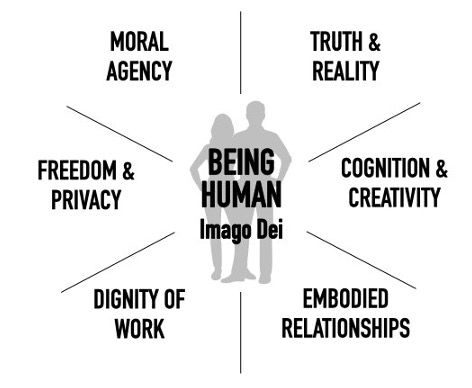
Figure 1: Six key aspects or attributes of what it means to be made in God’s image and after his likeness, developed from Jeremy Peckham, Masters or Slaves: AI and the Future of Humanity, IVP, 2021.)
How then does this anthropology work out in daily practice and ethics? Two principles provide a guide.
The first is that we are to image God (Eph. 5:1) in whose likeness we are made, albeit marred and spoiled by our rebellion against God that occurred at the Fall (Gen. 3). We are also are being conformed to the image of Christ (Rom. 8:29), confirming that Jesus, the Homo Deus and last Adam, is our template for what our character, behaviour and moral conscience should be. The second principle is that our motivation in life should be to bring God glory (1 Cor. 10:31) and delight in Him. As we do that, God delights in us (Zeph. 3:17, Is. 62:3-5).
In developing our ethics on any topic and on the use of technology like AI, we must ask whether it glorifies God: is it something in which he will delight? This must also be coupled with a consideration of whether it is consistent with imaging God’s character and with how Jesus would act. Does it detract from, dumb down or mar the image that we should display in the world. Through God’s self-disclosure in the Bible, we can discover God’s character. We also have the eyewitness accounts of how Jesus thought, spoke and acted. Both of these, as we shall see, give us the principles on which we can base a Christian view on the use of AWS and ADSS, particularly the use of AI in these fields.
Space precludes citing all the references in the Bible to God’s character but it is evident that we should speak the truth, exercise love through embodied relationships and use our moral agency – that is, our freedom to choose what is right – from which derives our general human freedom as well as our privacy. Engaging our minds to think critically helps us to exercise sound judgement and develop wisdom, qualities that the Bible speaks much about.
In 2 Peter 1:5, we are exhorted to “make every effort to supplement our faith with virtue” (Gk. ‘excellence of character’) and it could be argued that living virtuously is no more than a plea to display God’s nature in which we are made.
Being faithful in displaying God’s nature and glorifying him (as best we can with the Holy Spirit’s help) will of necessity ensure that the attributes of being human, shown in Figure 1, are being displayed by us and neither dumbed down nor diminished by outsourcing to an artefact.
Before considering precisely how this Christian Anthropology impacts our understanding of AWS and ADSS, we need to first address what exactly AI is. This is important because there is considerable confusion over the ontology of AI. And this results in false claims being made for its capabilities, which then in turn creates an ethical quagmire. Understanding its ontology also helps us to frame in what areas it can be usefully used in the light of the Christian Anthropology I have outlined.
What exactly is AI?
For the purposes of this paper, I will define two broad types of AI that are relevant in the discussion about its use in autonomous weapons and decision support systems, the topic of this article.
Discriminative AI is based on a pattern-matching algorithm that is trained on specific data, such as faces or MRI scans, in order to be able to identify a particular person or a malign tumour in the future. Such systems might be deployed in a drone weapon system to identify, track and even target a particular enemy combatant or terrorist. A fully autonomous weapon system could be programmed to destroy the target automatically, once identified at a pre-programmed level of probability, without any human intervention or supervision. Discriminative AI systems are also used in decision support systems where the training data might be anything from criminal offenders’ recidivism to a population’s individual credit rating. In war scenarios, this might be battlefield data or logistical information, used to model likely outcomes from a new set of data and parameters that would be input by military personnel. Machine Learning, the mathematical basis of the software used in AI systems, is widely used in cybersecurity for discovering potential breaches. The flip side is that bad actors can also use these techniques for finding vulnerabilities in organisations’ software infrastructure and then hacking them. Cyber ransom is a product of the use of such tools.
The more widely understood and experienced form of AI (at least since the launch of ChatGPT in 2022) is Generative AI based on Large Language Models (LLMs) that have been trained on vast quantities of data scraped from the internet. This includes natural language text as well as images. In this case, the models predict new text or images as output that best satisfy the input prompt. Such systems can also be used in decision support systems. The most advanced of these models are described as Frontier Models (leading edge) and these are now being combined with other programmes and AI systems to act autonomously – so-called agentic AI.
With both types of AI system, actions can be taken automatically on the basis of the match threshold in discriminative AI or the information output for Generative AI systems.
Generative AI systems have caused the most controversy and ethical debate because they output fluent natural language that can be indistinguishable from human output. This has caused many to describe these systems as thinking, reasoning and having human cognitive capabilities, even having the potential to surpass human thinking. These impressive capabilities and claimed futured potential are what lie, in part, behind the interest of governments and their military.
Unfortunately, there is much confusion over what AI really is and what it is capable of, both now and in the future. Our worldview influences how we think about AI. In the Christian Anthropology that I outlined above, we are made in God’s likeness to image him and to image Christ. That is our status, and we do what we do because of that status. But a naturalistic view tends to begin with what we do (and who we are springs out of that), which is a functional definition of what it means to be human. This plays out in how people interpret the capabilities of Generative AI. It goes something like this:
- If a computer behaves intelligently,
- then it is intelligent.
- If the computer is intelligent,
- then it must have a mind.
It is not surprising then that, at the extreme end, people will think of the brain as simply ‘wetware’– a biological computer that is decaying but that can be replaced with a computer. We can then upload our brains, and even create a super intelligence and achieve transcendence. From a Christian worldview perspective, this is essentially building a Tower of Babel – nothing more than an attempt to be God. But it is important to understand that, if you have that worldview, it will seem perfectly reasonable to those people to assume that it is possible to create artificial general intelligence and super intelligence. In an article in Nature, the authors claimed that we have already reached artificial general intelligence, “By reasonable standards, including Turing’s own, we have artificial systems that are generally intelligent. The longstanding problem of creating AGI has been solved.”8
Passing the Turing test proves just one thing – that a machine can generate fluent text indistinguishable from human language output. That is it. So where is the intelligence? It is actually an illusion of intelligence, simply because we often will define whether somebody is bright or smart by what they say or how they say it. But that is all it is. Mimicry or simulation does not equal intelligence. We do not call a parrot intelligent or ascribe it human intelligence because it can repeat the words of its master. In allusion to this, natural language researcher Emily Bender has coined the term “stochastic parrot” to describe Generative AI systems.9
Part of the problem in thinking about AI is that we use anthropomorphisms such as thinking, reasoning and intelligence to describe it. In fact, the term ‘AI’ was coined by John McCarthy in 1955 in response to the convening of a Dartmouth conference to explore whether machines could be made to reason like humans. McCarthy later went on to define Artificial Intelligence as: “the science of making machines do things that would require intelligence if done by people.”10 It’s interesting that Herbert Simon and Alan Newell, who attended the Dartmouth Conference, preferred the term ‘Complex Information Processing’ to AI as they felt it better describe what the field was about. This would have been a much more appropriate term, albeit not as exciting as AI – and it certainly would not have attracted the funding that AI has!
So-called Frontier AI systems are, for the main part, based on statistical predictors – apart from a few using neuro-symbolic processing (which is an approach combining statistical pattern matching with rule-based processes). Combining statistical and rule-based systems is not a new approach and was the basis for the Speech Understanding and Dialogue (SUNDIAL) project in the 1990s.11
After a LLM has been developed through an extensive training process, human feedback is provided in a reinforcement learning process where people select a preferred output to sets of questions or inputs, based on the goals and values of the organisation. This might mean that sycophantic responses are preferred because they keep people using the system.12 Guardrails are then added to prevent certain outputs or behaviours, such as preventing the output of instructions about how to make a bomb or chemical weapon. They are effectively temporary sticking plasters – and they can often be circumvented (which is known as ‘jailbreaking’).
Compared to the human mind, AI has a number of limitations (see Figure 2). It is inefficient; it is often incorrect;13 it does not generalise; it does not engage in critical thinking;14 and it has neither wisdom nor the capacity to make empirical observations.
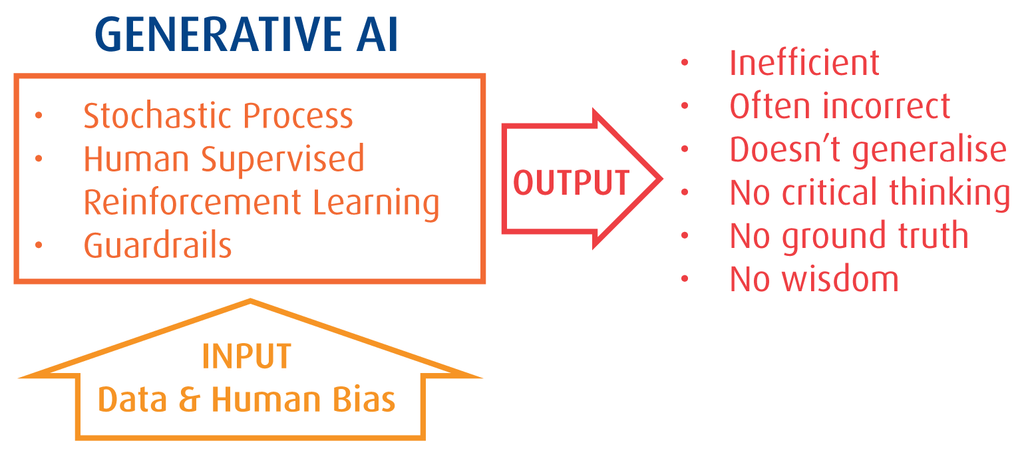
Figure 2: Generative AI and its relation to human generated text.
Equating AI with human intelligence is an ontological confusion, and when we do that, it leads to an ethical quagmire – particularly when we are thinking about using systems in warfare. A Christian Anthropology and its practical outworking provide clarity on how to think about the ethics surrounding the development and use of autonomous weapon systems and automated decision support systems.
The first question that we have to ask is this: is the development and use of these systems consistent with virtue? In other words, does it allow us as humans to exercise virtues such as self-control, wisdom and perseverance? More than that, might these systems actually diminish the development of these virtues as cognitive processing is offloaded to a computer? This is surely a particular concern where it concerns the control of an autonomous weapon or a decision support system. Ultimately, a Christian Anthropology informs us that humans alone have moral agency. This leads us to the question, is war ever justified? And if it is, what are the moral imperatives for engaging in it?
A Biblical View of War
Space precludes an extensive treatise on the Christian views of war, which range from just war theory to pacifism. Just war theory tends to be the default thinking for many Christians and others, even when the topic has not been thought about very deeply. Perhaps this is because of ‘Natural Law’, the idea that everyone, regardless of faith or culture, has a sense of what is right and wrong or what justice is.15 This is in line with our Christian Anthropology discussed earlier – that we believe that we are created in God’s image and likeness and that he is a moral, just and righteous God. That is not to say, of course, that human beings understand perfectly what is right, wrong or just. As we know all too well, sadly there are many occasions when people, governments and whole societies get this wrong.
A biblical perspective on war derives from both Old and New Testament writings.
The Old Testament Israelites were told that the shedding of blood by murder would “pollute the land in which [they] live” (Num. 35:33) and “You shall not defile the land in which you live, in the midst of which I dwell, for I the Lord dwell in the midst of the people of Israel.” (Num. 35:34) This attitude to murder mirrors what we have learnt from Christian Anthropology. Because we are made in God’s image, life is precious to God – and to take a life by murder mars that image in a significant way and offends the God who made us.
These prohibitions provide much of the context for the Old Testament accounts of war brought about by divine providence – including those initiated by God to enable the Israelites to conquer the Promised Land. Although abhorrent to many,16 those wars also require understanding of the context of contemporary Canaanite practices, which involved the sacrifice of children. God warns the Israelites, “You shall not give any of your children to offer them to Molech, and so profane the name of your God: I am the Lord.” (Lev. 18:21) Another Canaanite practice was the worship of the deity Anath, patroness of sex and war, whose bloodlust and massacre knew no bounds. The late archaeologist William Albright describes Anath with support from a fragment of the Baal Epic text:
The blood was so deep that she waded in it up to her knees – nay, up to her neck. Under her feet were human heads, above her human hands flew like locusts. In her sensuous delight she decorated herself with suspended heads while she attached hands to her girdle. Her joy at the butchery is described in even more sadistic language: ‘Her liver swelled with laughter, her heart was full of joy, the liver of Aneth (was full of) exultation (?).’ Afterwards Aneth ‘was satisfied’ and washed her hands in human gore before proceeding to other occupations.17
The reason for God’s judgement is clear: these were practices that marred the image of God in which the Canaanites had been created.
The Bible is clear that we should not be aggressors. We must not pick a fight for gain or from revenge (Rom. 12:19); rather, we should be peacemakers (Matt. 5:9). But the Bible also gives an individual (and, by inference, a state or group of people) the right to defend themselves. The Mosaic law concerning self-defence during a nighttime break-in allows lethal force whereas a daytime break-in does not (Exod. 22:2-3), presumably in recognition of the fact that darkness adds to the danger in which the intended victim finds themselves. In a similar vein, Nehemiah armed builders to protect their work, and Esther secured the right for Jews to defend their lives against annihilation (Est. 8:11; Neh. 4:14–18).
In the New Testament, we are instructed to “submit yourselves for the Lord’s sake to every authority instituted among men: whether to the king, as the supreme authority, or to governors, who are sent by him to punish those who do wrong and to commend those who do right.” (1 Pet. 2:13) This suggests that we should submit to governments’ and authorities’ rule if they seek to defend the nation against attack – perhaps even to defend others in another country against unjustified invasion.
Furthermore, the Roman officer who asked Jesus to heal his servant was a soldier of the occupying force – yet Jesus commends his faith and, as far as we know from the biblical account, says nothing about either the officer’s authority or vocation (Matt. 8:5-13). In a more explicit encounter, soldiers ask John the Baptist about how they should repent. He tells them not to extort money by threats or false accusation and to be content with their wages. This is an implicit acceptance of their vocation and roles as law keepers and soldiers.
This brief perspective on the biblical justification for war (often referred to as ‘just war’ or ‘just war theory’) is enshrined in a variety of international treaties and conventions on the laws of armed conflict, including the Hague and Geneva Conventions.
The Law of Armed Conflict
There are four principles underlying the law on armed conflict:
- Military necessity, which requires the actors to use only the degree and kind of force necessary to achieve a legitimate purpose, such as complete or partial submission with minimal expenditure of life and resources. This assumes that any such force is not prohibited by the conventions (for example the use of biological weapons).
- Humanity, which seeks to preserve human dignity and minimise suffering by prohibiting human suffering or injury that is not justified by military necessity.
- Distinction, which is the doctrine requiring commanders to separate combatants from non-combatants as well as military from non-military targets.
- Proportionality, which requires that any losses must not be excessive in relation to the military advantage gained.
- The clear intention behind these conventions is to minimise suffering caused by armed conflict rather than to impede military efficiency. They seek to ensure that prisoners and non-combatants are treated fairly and humanely and that suffering is not caused by a desire for revenge or aggression. The use of drones to kill civilians in Ukraine (described earlier) falls far outside of these parameters.
The moral weight of these four principles is clear – yet in the theatre of war, it is often a difficult task to fulfil them. Tensions often exist between minimising civilian casualties and achieving military objectives. Resolving these tensions relies on sound intelligence from the field, careful analysis and evaluation, as well as experience, judgement and wisdom on the part of those making decisions.
Resolving these tensions therefore requires characteristically human attributes. And yet frontier systems and their LLMs are already being used to assist in decision support and intelligence analysis. It is disturbing that anthropomorphisms (such as reasoning, theory of mind and deception) abound in the analysis and description of the performance of such systems. For example, Payne’s paper, cited earlier, states that, “We also find systematic failures and striking context-dependence—one model exhibits apparent passivity in open-ended scenarios, yet transforms into a calculated hawk willing to employ strategic nuclear weapons when facing deadline-driven defeat. Another demonstrates calculated ruthlessness that would alarm any student of nuclear strategy, including willingness to launch first strikes when perceiving vulnerability.”18
As I have pointed out, the danger behind such anthropomorphisms is that users might begin to attribute completely unwarranted capabilities to the systems they are using – notwithstanding the impressiveness and even helpfulness of their outputs in certain situations. The worry is that, because the outputs of these LLMs are (by and large) stochastic, it is to be expected that its outputs will be unreliable. In his response to the Trump Administration over Anthropic’s refusal to allow the military unrestricted access to their algorithms, Dario Amodi stated, “frontier AI systems are simply not reliable enough to power fully autonomous weapons”.19 The same argument is also true for decision support systems where confident and even aggressively worded outputs, purely derived from the predictive process, ought not to be considered – let alone relied on. Yet in the heat of conflict, it might be tempting to act on the instant decisions output by an LLM rather than take time to reflect and evaluate. As Payne summarises his own argument I, Warbot: “AI systems lack the embodied, emotional substrate that shapes human strategic judgment—for better and for worse.”20
Particularly in view of Christian Anthropology, the clear difference between AI systems and human beings leads me to argue that AI should never be used in a fully autonomous way for consequential actions for weapons systems. It should also not be relied upon for decision support.
I would also argue that cognitive outsourcing in the decisions and actions involved in both weapons systems and decision support will, over time, diminish skills, critical thinking, the development of good judgement and wisdom. Ultimately, humans are unique in having agency. We should not offload that agency, effectively giving proxy agency to a statistically based, non-deterministic artefact. A consequence of this position is to argue that AI-equipped weapons systems must always keep a human being appraised of the situation – and that consequential decisions must rest with people. But even with this caveat, AI systems require their users to exhibit considerable discipline (or even put safeguards in place) in order to avoid the temptation to rely on its output.
The counter argument to the above is that AI-equipped weapons systems will result in fewer deaths because they will reduce human error that can result in loss of civilian life, disproportionate killing of combatants or property damage. However, I am not aware of any empirical basis for this claim – and the LLM simulations run by Payne instead suggest that the opposite might prove true were such systems given free rein. Moreover, although the objective of reducing casualties lies in favour of the objectives of the law of armed conflict, the underlying ethical basis is utilitarian and consequentialist (that is, that the ends justify the means). And in a Christian worldview, the use of a lethal, fully autonomous weapon does not diminish moral culpability for the consequences of its action, especially where it is found to have infringed the principle of proportionality or discrimination. A commander is responsible for an AI-equipped weapons system being deployed; others are responsible for its servicing, arming and fuelling. Each individual involved has a share of moral responsibility.
How we use AI in autonomous weapons, decision support and in applications across society will have a long-term impact on humanity. This is because technology is not neutral. As Professor Melvin Kranzberg put it in his Kransbergs’ Laws, technology is neither good nor bad, nor is it neutral.21 Neil Postman put the same idea another way in his book, Technopoly: “Every technology is both a burden and a blessing; not either-or, but this-and-that.”22
Any piece of technology provides what philosophers of technology have called ‘affordances’, that is, different possibilities for use. An example might be that smartphone apps could be designed to allow users to sign up for the service in a way that engages them to think of it as a conventional bargain between two parties. This would require the user to read the contract. But in the case of social media this might run into hundreds of contracts between the service providers’ third parties. Of course, most people do not want to do that – and so the software is designed to require just a box tick to accept the contract and its terms and conditions. This design approach has shaped the whole software and service industry, normalising the use of a check box to onboard customers. In practice, most people do not know (and may not care) precisely what they have agreed to – especially when the service is free.
It is well known that social media algorithms have been designed to keep people engaged on the platform to maximise advertising revenue. Keystrokes (every key that you press on the keyboard) are collected and analysed to allow targeted feeds which are filtered to post the content, including adverts, which is most likely to appeal to a specific user. This has shaped whole societies and resulted in many cases in addiction and the attendant harms that can result from it, such as loneliness and depression, now appearing in studies of habitual AI Chatbot use.23
The design of any piece of technology is shaped by the values and incentives of the designers and their companies. This technology in turn shapes its users and eventually whole societies. As the use of a particular technology becomes normalised in society, designers of technology are themselves are shaped and influenced in what they create next (see Figure 3). In a military context, the same shaping is true. Reliance on AI systems will become the norm, potentially de-skilling a whole new generation of analysts, commanders and combatants.
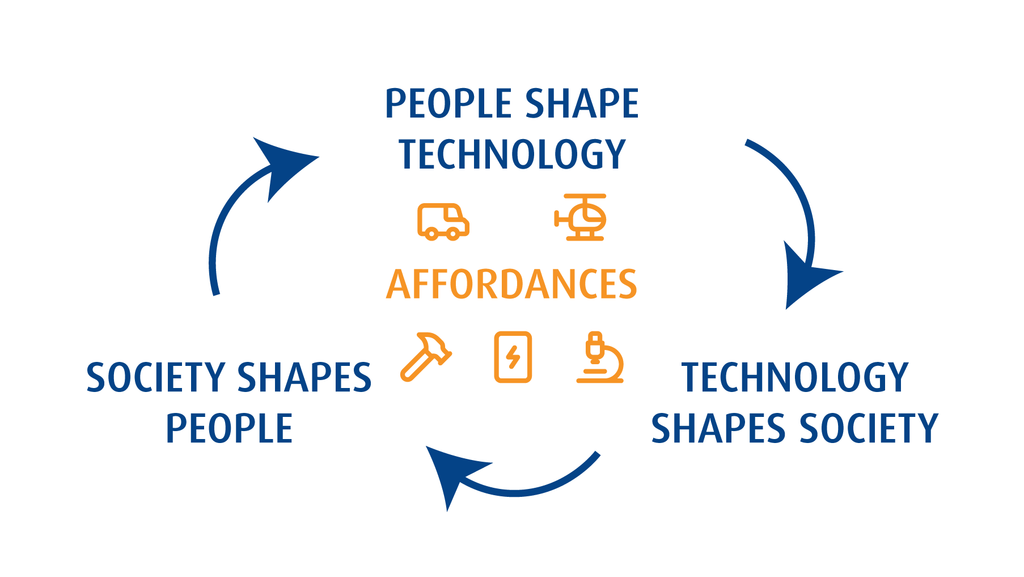
Figure 3: The cycle of how technology shapes us through the affordances it offers.
AI and Generative AI in particular is perhaps the first technology to simulate human natural language output in ways that can appear indistinguishable from human-generated thoughts. This has convinced many to outsource cognitive processes like writing and searching for information to AI personal assistants and chatbots. The impact of this habituation, rather like social media and internet addiction, is beginning to be realised. Studies are showing how such outsourcing is diminishing critical thinking abilities and writing skills. In the context of military operations, how might the skills, experience, judgements and wisdom of commanders, combatants and support staff be shaped over time through reliance on AI in decision support systems and autonomous weapons? The consequences of such reliance are yet to emerge, although some have speculated that the destruction of the girl’s school in Iran at the start of the US invasion might have been partly a consequence of using AI tools.24
Conclusion
From the perspective of Christian Anthropology, we need to navigate our use of technology in any sphere by balancing what is gained and what it does for us with what is lost in our humanness and what it does to us. These value judgements must be made in the context of our mirroring the image of God and of our imitating Christ. A further question might be to ask is this: why use AI and not a human expert, even though all of us are flawed? AI works on probabilities and approximate information retrieval and, though humans are also flawed, moral agency rests with us alone.
These are serious issues for society. But it is crucial that we navigate them in this increasingly unstable world where military technology is becoming ever more sophisticated and AI is seen as a key part of the arms race. As long ago as 2017, Russian President Vladimir Putin made this pronouncement to students: “Artificial intelligence is the future, not only for Russia, but for all humankind. It comes with colossal opportunities, but also threats that are difficult to predict. Whoever becomes the leader in this sphere will become the ruler of the world.”25
I have argued that AI is, by its nature, ontologically different from the embodied human mind in its fullest orb. I have also argued that AI is fundamentally unreliable and limited in its capabilities and that this should be a warning to use it with utmost caution (even with a human involved), especially where decisions and actions are consequential, whether to life or property.
In practice, this means that, where autonomous weapons are being used, there should always be a human involved who makes decisions and especially final judgements, taking into account military justification, humanity, discrimination and proportionality as defined in the Law of Conflict. I see these laws as in harmony with a Just War Theory derived from my understanding of the biblical texts outlined in this paper. These same principles apply to the use of AI in support functions, especially in critical scenarios and war gaming where outputs might be acted upon. AI developments need careful evaluation of their utility and should only be used in an assistive way that does not bypass human cognitive processes. AI can be extremely useful when used in the right context, such as pattern matching – as long as there is a recognition that it is imperfect. Cybersecurity is just one example where rapid analysis and flagging of potential threats does not replace people but rather allows human experts to evaluate the outputs, saving significant time in what would otherwise be an overwhelming task.
Given the human propensity to desire speed and efficiency and our temptation to sloth,26 the use of AI systems must be a well-informed strategic decision with adequate provisions for human input, analysis, reflection and the application of wisdom that can only be acquired over time. This is necessary to avoid overreliance on AI systems’ outputs, whether those are analysing intelligence, wargaming recommended actions or identifying targets.
The questions surrounding the use and impact of AI on people and whole societies are questions about which Christians and the church have an informed perspective and a significant contribution to make. We are called to speak wisdom into the world. Pope Leo’s Encyclical on AI is a case in point. The voice of other Christian traditions must be added to this, alongside informing and teaching our own congregations.
Whilst our influence may be limited, resolving the ethical and moral issues surrounding the use of AI in the military, our focus in this article, is crucial. In an age where individual values have replaced virtues and many are questionings what it means to be human, we need to bring back the supernatural into the debate in the public square. We need to reaffirm what it means to be human – what it is to be made in God’s image. Because, as Alexis de Tocqueville rightly observes, “When religion has lost its empire over the souls of men, the most prominent boundary which divides good from evil is overthrown.”27
- A First Person View (FPV) drone refers to drones that are remotely operated by a pilot who sees images relayed from an onboard camera through a headset that allows the pilot to feel as if they were flying the drone. ↩︎
- Andrew E. Kramer, ‘Russia Aims Drone Attacks at Civilians, a War Crime, U.N. Inquiry Says’, World, The New York Times, 27 October 2025, https://www.nytimes.com/2025/10/27/world/europe/russia-drones-target-civilians.html. ↩︎
- Felix Choussat, ‘Drone WMDs Don’t Need Any New Technology’, AI Frontiers, 20 July 2026, https://ai-frontiers.org/articles/drone-wmds-dont-need-any-new-technology. ↩︎
- Chris Stokel-Walker, ‘AIs Can’t Stop Recommending Nuclear Strikes in War Game Simulations’, New Scientist, 25 February 2026, https://www.newscientist.com/article/2516885-ais-cant-stop-recommending-nuclear-strikes-in-war-game-simulations/. ↩︎
- Kenneth Payne, ‘AI Arms and Influence:Frontier Models Exhibit Sophisticated Reasoning in Simulated Nuclear Crises’, accessed 4 September 2026, https://arxiv.org/html/2602.14740v1. ↩︎
- Unless otherwise stated, all Bible quotations are taken from the English Standard Version. ↩︎
- Y. N. Harari, Homo Deus: A Brief History of Tomorrow (Harper Collins Publishers, 2016). Harari surveys the progress of humankind and suggests that in the 21st Century, humans will seek to gain ever more God-like powers – hence the title Homo Deus (Latin: man-god). ↩︎
- Eddy Keming Chen et al., ‘Does AI Already Have Human-Level Intelligence? The Evidence Is Clear.’, Nature 650, no. 8100 (2026): 36–40, MEDLINE, https://doi.org/10.1038/d41586-026-00285-6. ↩︎
- Stochastic refers to the statistical and probabilistic nature of the processes that underly many AI approaches. Emily M. Bender et al., ‘On the Dangers of Stochastic Parrots: Can Language Models Be Too Big? 🦜’, Proceedings of the 2021 ACM Conference on Fairness, Accountability, and Transparency (New York, NY, USA), FAccT ’21, 1 March 2021, 610–23, https://doi.org/10.1145/3442188.3445922. ↩︎
- John McCarthy, ‘What Is Artificial Intelligence?’ (Stanford University, 2007), 2, http://jmc.stanford.edu/articles/whatisai/whatisai.pdf. ↩︎
- Jeremy Peckham, ‘A New Generation of Spoken Dialogue Systems: Results and Lessons from the SUNDIAL Project’, 22 September 1993, 33–40, https://doi.org/10.21437/Eurospeech.1993-4. ↩︎
- Myra Cheng et al., ‘Sycophantic AI Decreases Prosocial Intentions and Promotes Dependence’, Science 391, no. 6792 (2026): eaec8352, https://doi.org/10.1126/science.aec8352. ↩︎
- Wenting Zhao et al., ‘Wild Hallucinations: Evaluating Long-Form Factuality in LLMs with Real-World Entity Queries’, preprint, 24 July 2024, https://doi.org/10.48550/arXiv.2407.17468. ↩︎
- Parshin Shojaee et al., ‘The Illusion of Thinking: Understanding the Strengths and Limitations of Reasoning Models via the Lens of Problem Complexity’, preprint, n.d., accessed 4 September 2026, https://arxiv.org/html/2506.06941v3. ↩︎
- For an extensive treatment of Natural Law see J. Daryl Charles, Retrieving the Natural Law: A Return to Moral First Things (Eerdmans, 2008). ↩︎
- Many struggle with divine sanction of war because of the difficulty reconciling it with the command, “Thou shalt not kill” (Exod. 20:13, KJV). For more on this, see Tim Dieppe’s article in this edition of Social Issues. ↩︎
- Quoted in Paul Copan, Is God a Moral Monster?: Making Sense of the Old Testament God (Baker Books, 2011), 159. ↩︎
- Payne, ‘AI Arms and Influence’. ↩︎
- Dario Amodei is the CEO and founder of Anthropic. Dario Amodei, ‘Statement from Dario Amodei on Our Discussions with the Department of War’, accessed 4 September 2026, https://www.anthropic.com/news/statement-department-of-war. ↩︎
- Payne, ‘AI Arms and Influence’ ↩︎
- Melvin Kranzberg, ‘Technology and History: “Kranzberg’s Laws”’, Technology and Culture 27, no. 3 (1986): 544–60, https://doi.org/10.2307/3105385. ↩︎
- Neil Postman, Technopoly: The Surrender of Culture to Technology, Vintage Books edition (Vintage Books, 1992), 4–5, WorldCat. ↩︎
- Cathy Mengying Fang et al., ‘How AI and Human Behaviors Shape Psychosocial Effects of Extended Chatbot Use: A Longitudinal Controlled Study’, preprint, 2025, https://www.media.mit.edu/publications/how-ai-and-human-behaviors-shape-psychosocial-effects-of-chatbot-use-a-longitudinal-controlled-study/. ↩︎
- Kevin T. Baker, ‘AI Got the Blame for the Iran School Bombing. The Truth Is Far More Worrying’, News, The Guardian, 26 March 2026, https://www.theguardian.com/news/2026/mar/26/ai-got-the-blame-for-the-iran-school-bombing-the-truth-is-far-more-worrying. ↩︎
- Joseph Trevithick, ‘Putin Says Whoever Has the Best Artificial Intelligence Will Rule the World’, TWZ, 6 September 2017, https://www.twz.com/14141/putin-says-whoever-has-the-best-artificial-intelligence-will-rule-the-world. ↩︎
- Sloth (Latin ‘acedia’) is much more than simply laziness. In its full meaning, it can be a lack of care or attention to doing what is right and it can quench the Holy Spirit and work against imitating Christ. ↩︎
- Alexis de Tocqueville, Democracy in America, trans. Henry Reeve (Oxford University Press, 1965), 256. ↩︎

Related articles



Stay connected with our monthly update
Sign up to receive the latest news from Affinity and our members, delivered straight to your inbox once a month.