
Book Review: Hope for God’s Creation
This book review was first published in our recent Social Issues Bulletin – Issue 59, which is available to download here.
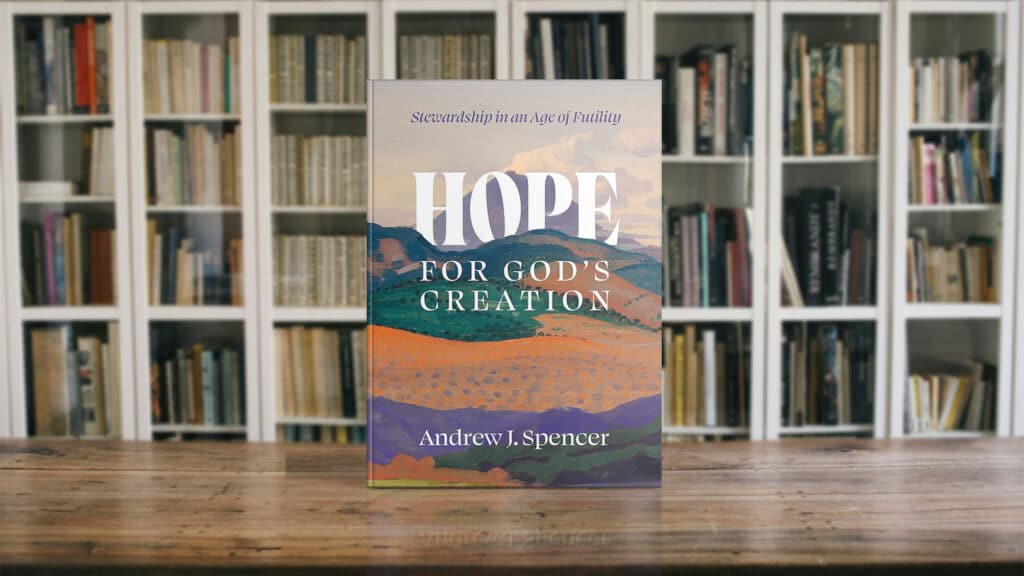
Hope for God’s Creation: Stewardship in an Age of Futility
By Andrew J. Spencer
B&H Academic, 2023. (176pp. £18.69, Amazon.co.uk)
The book aims to provide a Christian theology of creation care rooted in gospel hope. In this it partly succeeds. ‘Partly’ only because I found the book a little too wordy, discursive and hard work. Hard work in the sense that it was difficult to pull all the many (particularly theological) strands together into a clear mental picture. The key points of the discussion are covered, but the narrative at times segues from one point to another and left me wondering where I’d come from and why, and as a serial read I struggled to maintain attention. This, of course, could just be me.
The book draws on Francis Schaeffer’s Pollution and the Death of Man, published in 1970. Schaeffer reflects that era and focuses on ecology, whereas Spencer is also engaging with today’s big issue of climate change. I found myself referring to Schaeffer’s sharper 55 pages to keep focused as I followed Spencer’s twists and turns. Schaeffer is, I think, more theologically penetrating and spiritually direct in taking you to the core principle and challenge driving Christian environmentalism: I love God, I love what he has made. If I don’t love what God loves, do I really love God?
Hope for God’s Creation is generally easy to read but does require a reasonable level of theological understanding and is perhaps best suited to theology students. It has the feeling of an academic thesis adapted for group Bible studies; it contains 657 references, and each chapter is usefully summarised, with a conclusion and an accompanying list of keywords and study questions. This is no bad thing as the issues it covers, particularly in translating our theology into practice, do not have quick and easy answers.
Its stated audience is, on the one hand, faithful, orthodox Christians who have seen little reason to practice creation care and on the other, readers who are passionate about environmentalism and are questioning whether Christianity can be good for the environment. It certainly provides meat for these audiences and for those drifting in the turbulent waters between these states. If you sit in the first category, the one I’m closest to, you will be challenged. If you are closer to the second group, perhaps less so.
Neatly divided into three parts – The Background of Creation Care, A Theology of Creation Care, The Practice of Creation Care – it provides opportunities for section hopping. For example, tackling first some of the thorny issues raised in Part 3 may well stimulate a search for answers in Part 2.
Part 2, A Theology of Creation Care, is covered in five chapters: A Theology of Creation Care, Sources of Moral Authority, The Value of God’s Creation, Anthropology and Stewardship and Near and Distant Hope for God’s Creation. This last chapter explains Schaeffer’s ‘substantial healing’ concept, which is presented as the practical aim of Christian environmentalism. It’s worth waiting for, but you do have to wait.
The ‘Hope’ of the title is the hope of a renewed creation at the end of this present age. Spencer discusses renewed creation, new (ex nihilo) creation and destroyed creation and concludes that renewed creation is the best reading of Scripture and the one that generates the most convincing hope to motivate substantial healing. I agree on the renewed version, but it’s not clear from Spencer’s treatment of these ultimate scenarios that the other interpretations don’t lead to an equally motivating outworking of the core biblical principle.
He takes, for instance, the position of Gale Heide, who concludes that a finally destroyed creation provides us with little more than a stewardship responsibility, whereas a renewed creation, perhaps, requires more.
This approach seems to detract from the key argument for renewed creation, which is that, like our renewed bodies, renewed creation will in some way bear the evidence of its treatment in this age. Christ’s risen body bore the scars of his crucifixion; renewed creation will bear the evidence of our scarring and our healing. Consequently, if renewed creation works in this way, it is clearly more motivating for Christian action now than the alternatives.
Surprisingly, Spencer invokes a form of Pascal’s wager argument to justify a Christian environmental stance where a person might doubt catastrophic climate change. Pascal’s argument is primarily a utilitarian one. In this context, it demands a view of nature valuing it either intrinsically or instrumentally, rather than valuing it for its inherent worth as created by God. While Spencer does not wholly reject instrumental value, he rightly prioritises inherent value. Using a Pascal-like wager as a motivation for Christian action shifts the focus away from God – the love of what God loves – a position he argues against elsewhere in the book.
Part 1 provides a comprehensive review of historical and contemporary debates and positions around environmental ethics and sets the context for a biblical Christian approach. He argues against a ‘big idea’ approach because it can easily become an ideology, where one central animating idea justifies any means to meet its ends. He encourages Christians to engage, but in mindfulness of our greater gospel responsibilities and points out that ‘The planet will survive, and God’s purposes will not be thwarted by our action or inaction toward better environmental stewardship’ (p. 26).
He tackles the criticism raised by Lynn White in a 1966 paper to the American Association for the Advancement of Science that Christianity is at fault for contemporary ecological problems. As Schaeffer did before him, Spencer acknowledges truth in White’s argument but concludes that the problem is not that Christianity is bad for the environment as White maintained, but that bad Christian theology, leading to bad actions, is bad for the environment.
In Part 3, Spencer concludes with three chapters on practical application. The first of these chapters covers environmental activism in the context of the wider mission of the church and again alerts us to possible distractions from our primary mission. The second chapter (Chapter 9) deals with conspiracies and conflict and warns that an emphasis on conspiracy thinking or political conflict undermines the gospel. Having identified and discussed the hazards that could shipwreck our Christian engagement, the final chapter of the book focuses on everyday practicalities. These are helpfully encapsulated in terms of Paul’s exhortation to the church at Thessalonica: ‘…and to aspire to live quietly…’ (1 Thess 4:11). Spencer posits that a quiet life tends to be more ecologically sound and more spiritually healthy.
If you are seeking to work out and examine what a Christian view of ecology and environmentalism looks like with a view to applying it in your Christian life, this book is sound and will be helpful. As mentioned earlier, it is probably most effectively employed in the context of group Bible study.
The above review was submitted by an independent, bona fide contributor, who, for professional reasons, has asked to remain anonymous. We are happy to agree to this request.
Related articles


Stay connected with our monthly update
Sign up to receive the latest news from Affinity and our members, delivered straight to your inbox once a month.