
Book Review: The Environment
This book review was first published in our recent Social Issues Bulletin – Issue 59, which is available to download here.
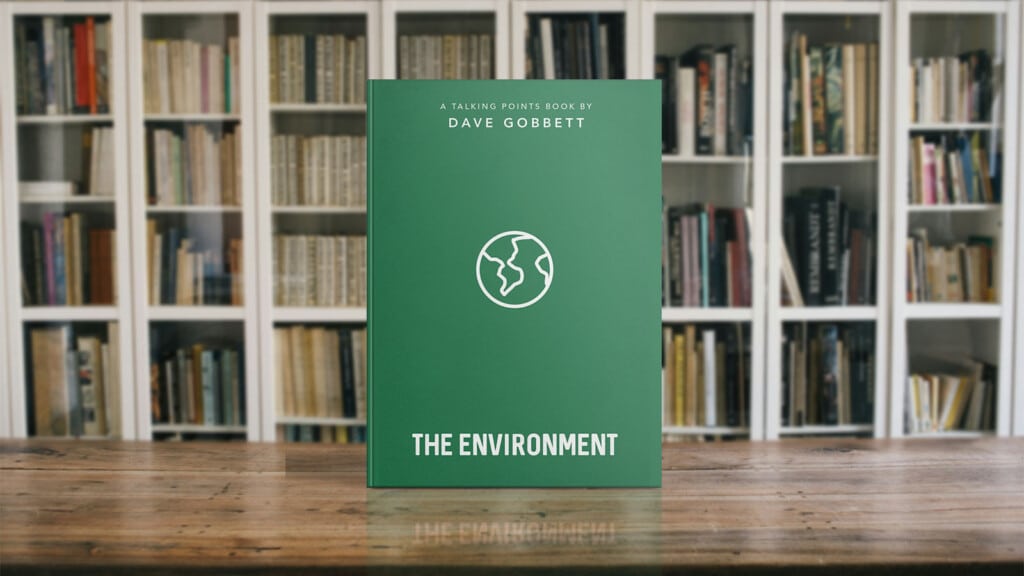
Environment: Christian Compassion, Convictions and Wisdom for Today’s Big Issues (Talking Points)
By Dave Gobbett
The Good Book Company, 2022 (80pp. £3, The Good Book Company)
This short book is part of the helpful Talking Points series produced by The Good Book Company. Other topics covered in the series include: Abortion, Assisted Suicide, Porn, and Transgender. The idea for the series is to have short biblical introductions to current controversial topics.
In this aim, Gobbett succeeds admirably. He uses Greta Thunberg’s apocalyptic, ‘I want you to panic’ as a starting point for discussion. There is a short history of the environmental movement highlighting, for example, the ozone layer, Al Gore’s Inconvenient Truth, the 1997 Kyoto Protocol, the 2015 Paris Agreement, and current ‘net zero’ targets. Some key stats on pollution, biodiversity, and deforestation are provided before he asks: ‘how we are to respond?’
Gobbett outlines three ways people respond to environmental issues. First, panic – this is Greta Thunberg’s approach, second, passive – we can’t do much about it, and third, prudence – this is Gobbett’s middle way between the two other extremes. He neatly deals with the foolish objection that evangelism is all that matters, and argues that Christians should be keen to talk about environmental issues since we have something positive to say – in contrast to issues like sexuality or gender identity when it can feel like we are constantly on the defensive.
He outlines a biblical theology of the environment, with a perfect creation damaged by the fall, and helpfully points out that environmentalists often idolise the planet, while those passively avoiding the issue may equally be idolising personal autonomy! He notes the promise of Genesis 8:22 that ‘cold and heat, summer and winter, day and night, will never cease’, pointing out that even if the climate is changing, God’s promise here rules out apocalyptic environmentalism.
There is some more theological analysis of the biblical mandate for creation care from Genesis 1. He notes that ‘human’ (Hebrew ‘adam’) is made from the ‘ground’ (Hebrew ‘adam-ah’) which parallels ‘husband’ (Hebrew ‘ish’) and ‘wife’ (Hebrew ‘ish-shar’). He argues that this suggests a strong link with humans and creation, captured by the English word ‘husbandry’. The Hebrew ‘adam’ is a gender neutral term for ‘human’ so Iain Provan suggests ‘earthling’ would be a better translation.[1] There is clearly a word play here suggesting similarity of material, and perhaps interdependence, though inferring responsibility from this word play feels like a stretch to me. In any case this is not the strongest point to make from the text.
What Gobbett doesn’t tackle is the meaning of Genesis 1:26 where humans are given ‘dominion’ over other creatures, or verse 28 where they are told to ‘subdue’ the earth. These verses are misused to argue that Christian theology justifies man’s exploitation of nature for his own ends without care for creation. The allegation made, in the words of Lyn White’s incredibly influential article from over 50 years ago, is that Christianity is ‘the most anthropocentric religion the world has ever seen’.[2] I suggest that Gobbet would have done better to address a proper interpretation of these verses rather than the word play around ‘adam’ and ‘adam-ah’.
Gobbett has a helpful chapter on eschatology in which he argues on the basis of various Bible texts that ‘the implication definitely seems to be that one day we’ll move out of this place … and go to another place – a better place’ (p61). Some would argue for more eschatological continuity, but even with a discontinuous view, Gobbett notes that we will still be held accountable for our treatment of creation. Further, our treatment of creation is part of Christian witness, and our confidence in biblical eschatology means we can dismiss the claims of apocalyptic environmentalists.
Gobbett concludes with a postscript, copying the title of Greta Thunberg’s bestselling book: No One Is Too Small to Make a Difference.[3] Here he relates what a day in the life of a Christian engaging prudently with creation might look like.
Gobbett writes well, with an engaging style. The book is highly readable, and its shortness will appeal to those lacking the time or motivation to engage with a more in-depth treatment. Some resources for further study are also provided at the end. It is a useful and up-to-date short introduction to a biblical perspective on the environment. It comes recommended for that purpose.
Footnotes:
[1] Iain Provan, Seriously Dangerous Religion: What The Old Testament Really Says and Why It Matters (Waco, Texas: Baylor University Press, 2014), 80
[2] Lynn R. White, “The Historical Roots of Our Ecological Crisis,” Science 155, no. 3767 (1967), 1205
[3] Greta Thunberg, No One Is Too Small to Make a Difference, (Penguin, 2019)

Related articles


Stay connected with our monthly update
Sign up to receive the latest news from Affinity and our members, delivered straight to your inbox once a month.